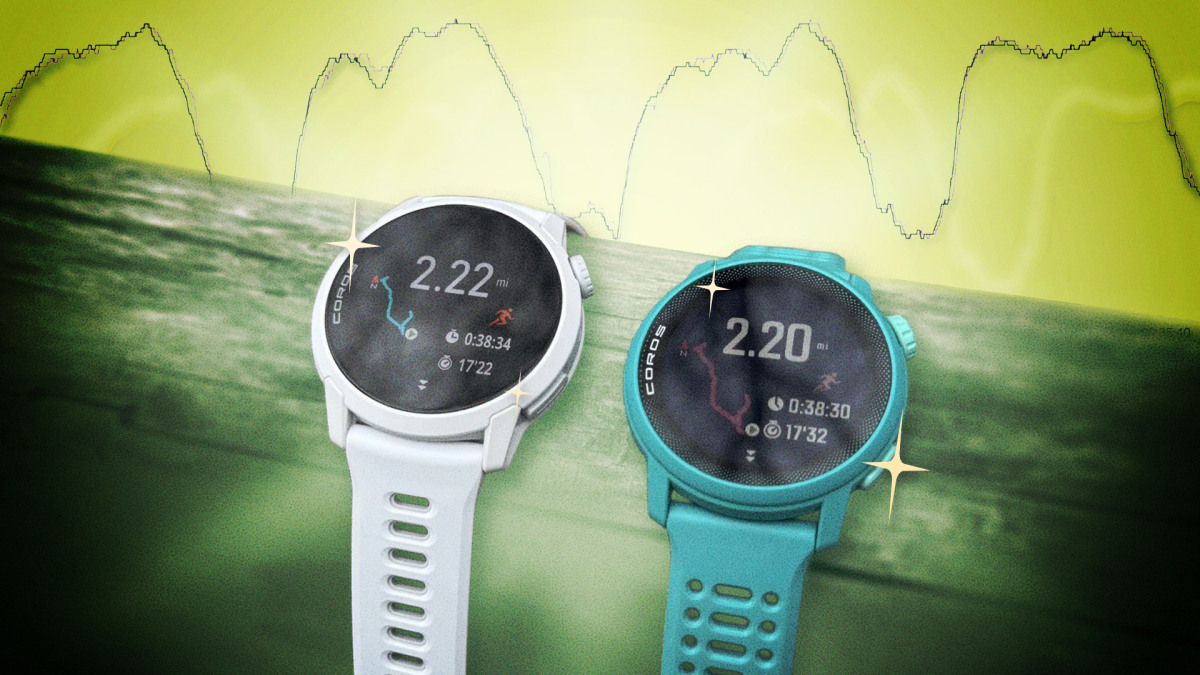
Coros makes great running watches that are seriously underrated. The Pace 4 ranks as the best running watch under $250, and the Pace Pro (with its larger screen and offline maps) is excellent, too. While Coros watches do the basics quite well, they also have a surprising number of useful yet often hidden features. Here are 10 tips and tricks for getting the most out of your Coros running watch.
Use the Extender for Detailed Maps While You’re Running

The Pace Pro watch has maps built in; the Pace 4 just has basic navigation without maps. But whichever you have on your wrist, you may not have realized you can pull out your phone during a run to see a detailed map — with satellite view — right on your phone. Instead of fiddling with the controls on your tiny watch screen, you can zoom on your phone as it updates in real time with your location and the path you’ve run so far.
To use this feature, just open the Coros app on your phone while you’re running. Right at the top of the main screen, you’ll see a card with your current live activity. Tap that card and you’re in what Coros calls the Extender, a tool that lets you view data from the activity and even update some information directly to the watch.
There’s a lot you can do with the Extender — we’ll look at the Adventure Journal later — but mapping is hands-down its best feature. If your watch doesn’t have maps (like the Pace 4), you essentially get them here for free. And if your watch does have maps (like the Pace Pro), you can view a higher-resolution map, with easier-to-operate controls, from this screen instead of making do with what’s on your watch.
Get Your Stats Every Mile Without Creating a New Lap
By default, Coros watches will mark a lap for you every mile if you’re not doing a specific workout. This is nice because the watch will show your time and pace for that mile. It’s a pretty standard feature.
But this also means that when you look at the activity later, you’ll see each mile as its own lap. If you want to track a different set of laps — the first versus the second loop around your neighborhood, perhaps — the auto laps will interfere.
Fortunately, a recent update changes that. You can now program automatic laps separately from distance alerts. Here’s how to get the best of both worlds:
- On the watch, go to the Run mode (or Trail Run, etc.), go to Auto Lap, and change it to OFF.
- Also under the Run (etc.) mode, go to Activity Alert, then Distance Alert, and make sure it is set to ON. You can set a distance here, which you probably want as 1.00 mile.
- If you want to hear your time and pace out loud when the alert arrives, go back to that run mode and change Voice Alert to ON.
This way, you’re able to do two loops of a two-mile trail and end up with two laps — one for each loop — while also getting a reminder every mile of your pace.
Load a Route (Even If You Know Where You’re Going) to Get Hill Alerts

This is another new-ish feature, and it’s a great one if you run a lot of hilly trails. Coros has Hill Alerts that will tell you when you’re starting a major uphill section, and it will let you know how many more hills you have waiting for you. You can preview the hills on the whole route, or just wait for the alerts to surprise you as you’re running. These are useful for pacing yourself, since you’ll know how long of a hill is coming up.
To use this feature, though, the watch has to know where you’re going. Create a route from the Explore tab, or download one you created in another app like Strava. Then tap Sync with your watch. With a library of routes saved for your favorite trails, using this feature is as simple as choosing a route from the same screen where you start your run. Instead of hitting Start, just scroll down to Navigation and select the route you’re running.
Fix Your Voice Training Notes in Two Ways
After you finish an activity on the Pace 4, you can record a little voice note with anything you’d like to remember about the activity. This is incredibly useful for strength training — you can read in the highlights of your workout log — and for runs, you can note how the activity felt or what factors may have affected your performance.
But sometimes you miss something you wanted to include, or you otherwise screw up the recording. If you don’t notice this until later, you have two options that each show up a little differently.
One is to fix it from the watch. From the watch face, scroll or swipe up to see your widgets. One of the widgets shows your previous activities. Select the activity, scroll down to the voice note, and re-record it. This overwrites the old recording, and if you wait a few minutes, the transcription in the app will be redone as well.
Or you can edit it as text from your phone. The original voice note gets transcribed into text, but if you hit the garbage can icon next to the note on your phone, the voice recording disappears and you now just have a text box where you can edit the text (or add to it) as much as you’d like.
Dismiss the Lap Screen Instantly by Turning the Dial
This is a tiny hidden feature that’s easy to miss. Whenever you mark a lap — or the auto-lap feature marks a lap for you — a screen with that lap’s statistics stays on your watch for what seems like forever, approximately eight seconds. But if you’d like to get back to your regular screen immediately, there’s a simple way: just turn the dial a click or two. The lap is still marked, but the screen goes away.
Set Up a Running Routine with the Coros Training Hub
You probably knew you could download a training schedule to the Coros app and thus to your watch. (If you didn’t: go to the Training Plan Library under settings to see all your options.) But there’s another way to get runs showing up as scheduled — add them yourself on the calendar in the Coros Training Hub.
The Coros Training Hub is a website that provides a much easier interface for planning than the phone app does. To use it, go here (the link will only work if you’re logged in to your Coros account). Click the calendar icon on the middle right side of the screen, then select or create a training plan.
Here’s how to create a basic schedule in minutes. Click a day, then hit “Quick Workout” and fill in the essentials — for example: Run, 3 miles, no pace target. Once you’ve created that workout, you can copy and paste it to other days. You can set up easy runs on weekdays and a longer run on the weekend, get a month’s worth of scheduling done quickly by changing some details each week, save the training plan, and then drag it to any future date on the calendar.
Once set up, scrolling to the widgets on your watch lets you see what run you’ve scheduled for today, tomorrow, or later in the week. And when you start a run, the watch will ask if you’d like to do the planned workout.
Navigate the Watch Screen Layout
If you ever find yourself on a strange screen while you’re running and don’t know how to get back to the screen you were on, it’s likely because Coros changed the screen layout — reportedly twice in recent updates.
On the Pace 4, the action button on the lower left side of the watch switches between navigation, music controls, and your regular activity data screens. When you’re on a data screen, scrolling or swiping up and down cycles through the different data screen variations. Think of it as three different columns: scroll up and down within a column to see all the variations for that view, or use the action button to move sideways to the next column. Keeping this mental model in mind makes it much easier to find your way back to the screen you want during a run.