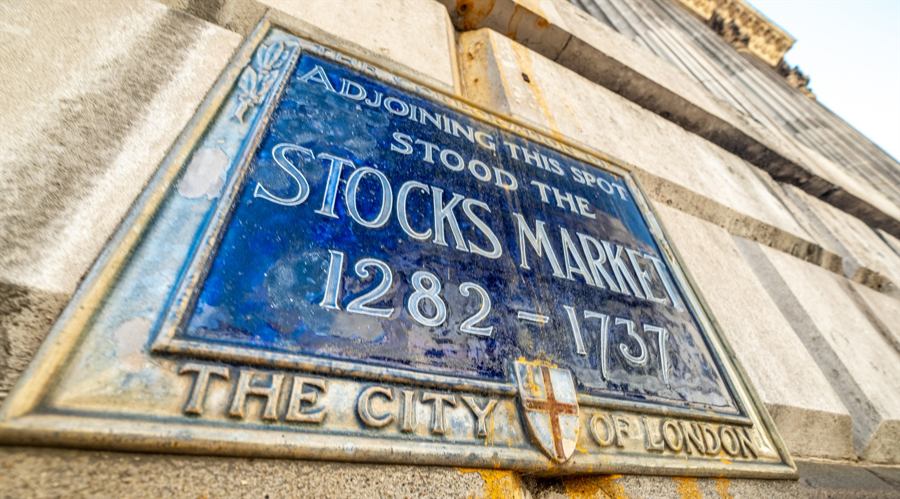
 Historic City of London former Stock Market location on what is now Mansion House (Shutterstock)
We Don’t Need No Education
A few weeks back, I wrote about how finfluencers increasingly represent the first introduction to the world of investing for those who have grown up in the social media age.
The column referenced a well-known Norwegian financial influencer who agrees that many young people come across financial ‘experts’ online and that when good financial education is missing, weak advice has more room to grow.
This would seem to lead to the conclusion that financial education needs to be built into the school curriculum. A number of countries have already made financial education a formal part of the school timetable, although even advocates recognise that the extent and quality of implementation vary significantly.
Indeed, the CEO of Blackbullion, Vivi Friedgut, whose mission statement is to become ‘the dominant financial wellbeing and data intelligence platform for Gen Z’, recently suggested that most teachers don’t feel confident enough to teach it and, in any case, are already stretched for time.
Her view is that adding financial education could act as a distraction from core subject teaching and that it should instead be embedded into subjects that already exist — for example, compound interest is maths, while understanding a contract would fall under the umbrella of personal, social, health and economic education. This could be supplemented by bringing in engaging experts.
However, the former president of a Council for Economic Education programme in the US reckons current research indicates that a standalone course has six times greater behavioural impact than embedding it in another course.
He suggests that educators are flocking to free, high-quality professional development to meet student demand for personal finance education, even in states that do not have a personal finance requirement.
An important caveat is that making financial education compulsory does not automatically lead to better outcomes. OECD analyses suggest the greatest gains come where financial education is introduced over several years rather than as a one-off course, linked to real-life situations such as bank accounts, taxes, digital payments, and borrowing, supported by well-trained teachers and reinforced by parents and community initiatives.
Hindsight Is Not Always a Wonderful Thing
Hollywood loves a time traveller, whether that’s Marty McFly trying to keep his parents from splitting up and threatening his existence or the Terminator trying to kill the woman destined to give birth to a man who will save all of humankind from extinction.
At some point, we have all wondered what we would do if we could go back in time. The most common objective would probably be to spend time with a loved one who is no longer with us — but what about the chance to use our future knowledge to make a killing on the stock market?
Well, according to a group of investment managers from Elm Wealth, we’d be wasting our time.
In late 2023, Victor Haghani, James White and Jerry Bell created the ‘Crystal Ball Challenge’, where they gave 118 finance-trained adults $50 each and handed them the front page of the Wall Street Journal one day before publication, with any mention of market moves blacked out.
These investors could go long or short on the S&P 500 and 30-year Treasury bonds, with leverage if desired. For example, after being shown Wednesday’s front page (reporting on Tuesday’s events), they placed their trades at Monday’s close and were closed out at Tuesday’s close, once the news had played out in the market. Each player got 15 trading opportunities, one front page per year from 2008 to 2022.
The result? On average, they broke even and a significant number went bust. They weren’t great at inferring market direction from the crystal ball, but they were particularly bad at position sizing.
On average, the 118 participants finished with $51.62 from their $50 investment, resulting in a 3.2% return that the firm characterised as statistically similar to breaking even. Over approximately 2,000 trades, the players accurately predicted the movement of stocks and bonds only 51.5% of the time — only slightly better than random chance.
The Crystal Ball Challenge underscores a lesson that applies as much to retail investors as to finance professionals: even with an informational edge, poor risk management and position sizing can neutralise any advantage. It is a finding that adds important context to debates about market structure, investor behaviour, and whether extending trading hours — as the LSE proposes — will genuinely serve the interests of the investors it aims to attract.