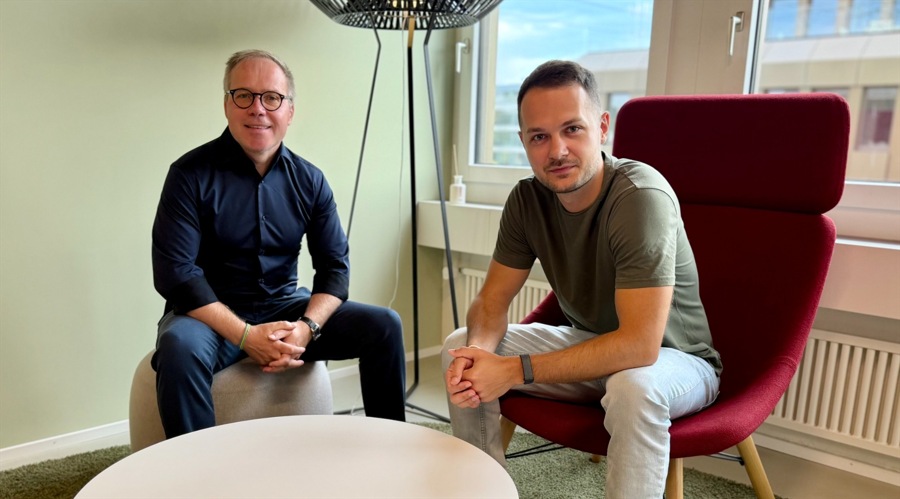
“You could almost argue that risk is my middle name.” Ingmar Mattus, who co-founded Tickmill in 2014 and has spent close to two decades making risk management decisions inside brokerage firms, was explaining what drew him to TradersYard, the Vienna-based proprietary trading firm he has backed since 2023 through his Swiss private equity vehicle, Andromeda Capital Partners. It was precisely that expertise TradersYard co-founder Manuel Sonnleithner said his own team was missing going into the deal. “We were not risk managers, we were tech people with a lot of experience in trading technology, but not on how the risk management works behind it.”
Mattus’s line could just as easily stand in for his broader assessment of retail trading in 2026: an industry he believes has become considerably harder to build in, and considerably less forgiving of firms that get it wrong.
Speaking with Finance Magnates, Mattus was joined by Sonnleithner, whose read of the current climate was, if anything, blunter. “Many firms will die over the next one, two years, as it’s happening,” Sonnleithner said of the wider prop trading and broker landscape. Together, the two laid out why launching and scaling a brokerage today bears little resemblance to what it took when Mattus started Tickmill twelve years ago, why a string of well-known industry names have recently sold up or closed entirely, and where Andromeda’s growing cluster of financial services firms is headed next.
Tickmill Had “a Little Bit of Luck”
Back in 2014, Mattus said, competition was thinner and regulation looser, and Tickmill had “a little bit of luck” on its side too. What has changed since, in his view, is that a CFD broker launched today is no longer competing only with other CFD brokers. It is competing with futures brokers, with prediction-market platforms such as Kalshi and Polymarket, and with standard equity brokers offering leveraged options, all chasing the same client.
He drew a parallel to the binary options era roughly six or seven years ago, when the more gamified product pulled flow away from CFD firms because it was simply easier to sell.
That pressure, Mattus argued, is not confined to Europe, where binary options remain banned, and event contracts occupy similar territory. Outside the region, US-based prediction-market operators are competing with CFD and futures brokers alike for the same retail traders.
Regulation has tightened alongside the competition, and not only the rules written by governments. “By regulations, I don’t only mean the regulations coming from governments,” Mattus said. “I also mean various policies that financial institutions have in place. Back in the days, it was much easier to open bank accounts for brokerage firms. But today, even when you talk about banks, it’s much more difficult to even get a bank account open for a newly established brokerage firm.”
Asked why so many established brokerage names have recently exited the business, sold up, or closed down entirely, Mattus offered four explanations.
The first is risk management: client flow, he said, has become harder to hedge as retail traders increasingly act in coordinated groups, sometimes thousands strong, placing identical trades that are too large to offset externally. The second is regulation, and he cited ESMA’s 2018 CFD leverage restrictions as the clearest example, a rule change that pushed profitability down across Europe and drove several larger firms to scale back or leave the region entirely.
“When we were looking at some of the bigger firms exiting Europe back in the day, we were almost laughing in the sense that it just felt completely irrational to leave Europe,” Mattus said. “But over time, of course, you come to realise that possibly it’s much more beneficial for business if you’re focusing on regions that have more friendly regulations.” The third is competition from adjacent products, and the fourth, he said, is a mindset problem.
”The Mindset Needs to Be Different”
CFD products generate more revenue per client than exchange-traded alternatives such as equities or futures, and that gap, according to Mattus, has made it extremely difficult for CFD firm owners to embrace lower-margin products even when client demand has clearly moved that way. “Steve Jobs (who reiterated Henry Ford) used to say that clients don’t know what they want, we need to tell them what they want, which is maybe the mindset of a typical CFD broker,” Mattus said. “But I think the mindset needs to be different, that you need to constantly be on top of things as to what products are attractive to the audiences out there.”
If traders want ETFs, cash equities, or perpetual futures, he said, brokers should launch them regardless of the thinner margins, because “it’s irrelevant what you think you should do. It’s relevant what the market wants you to do.”
He pointed to the speed gap between legacy brokers and newer platforms as evidence of the same problem. Kalshi, the US prediction-market operator, can launch a new product on its platform in around minutes, Mattus said, while a typical CFD or equities broker can take months to add a new asset class. “In 2026, with AI, with all this competition, whether in the prop industry or any other industry, the speed of delivering stuff is of utmost importance,” he said. “You just can’t sit on things, develop, and analyse. You have to deliver things.”
CFD brokers pushing into US futures and options, following IG and Plus500 into the market, is the clearest sign of firms trying to adapt, in Mattus’s telling, and a fairly obvious move given how closely CFDs and futures resemble each other from a client’s perspective. Mattus made a similar bet with MetroTrade, a Chicago-based futures and options introducing broker registered with the US Commodity Futures Trading Commission that he launched through Andromeda in 2024.
”We Will Build Everything In-House”
TradersYard’s own path illustrates the diversification problem from the other side of the table. The company began in 2013 as a professional trading platform sold into German-speaking markets under a different brand, before Sonnleithner and his team built TradersYard itself in 2020 as a social network for traders, filling a gap that Discord had not yet occupied.
There was no plan to move into prop trading when the first conversations with Mattus began in autumn 2022, following a meeting at a World of Trading conference in Frankfurt. Andromeda’s investment, agreed in 2023, came with a condition attached. “The deal was that we would not use any third party. We will build everything in-house,” Sonnleithner said. “No dependencies on anybody, just the talented team we had built there.”
The deal, Sonnleithner confirmed, was structured in two tranches: an initial €3.5 million, followed by a milestone-based €1.5 million once TradersYard proved it could deliver on a tight technical timeline, for a total of €5 million. “It was not an easy time to raise money at all,” he said of the 2022 to 2023 fintech funding environment, when high interest rates had cooled investor appetite and valuations across the sector had dropped. “We saw the vision with Ingmar as a strategic backer,” Sonnleithner added, noting that the combination of Mattus’s risk management expertise and Andromeda’s capital gave TradersYard the foundation it needed to execute its global expansion plans.