We may earn a commission from links on this page.

I love my Garmin Forerunner 165. So when Garmin announced its successor, the Forerunner 170, I had to find out: How much did Garmin really upgrade this model? After testing both and comparing them in-depth, here are my thoughts on which watch is actually a better value, depending on what kind of runner you are.
Is the Cost of the Garmin Forerunner 170 Worth It?
The Forerunner 170 costs $299, compared to $249 for the 165 at full price. The music versions follow the same pattern, with the 170 Music landing at $349 versus $299 for the 165 Music.
On paper, that’s a $50 difference. In practice, though, the gap is wider. The Forerunner 165 goes on sale constantly, and at the time of this writing, you can regularly get closer to a $100 difference between the two watches. Even if the 170 is technically the “better” watch, that doesn’t necessarily make it a better value than the 165.
There’s also a newer, cheaper option worth mentioning: the Garmin Forerunner 70, which launched alongside the 170 at $249. It covers most of the same ground as the 170, and I plan to write an in-depth comparison of the two watches soon.
What the Garmin Forerunner 165 and 170 Have in Common
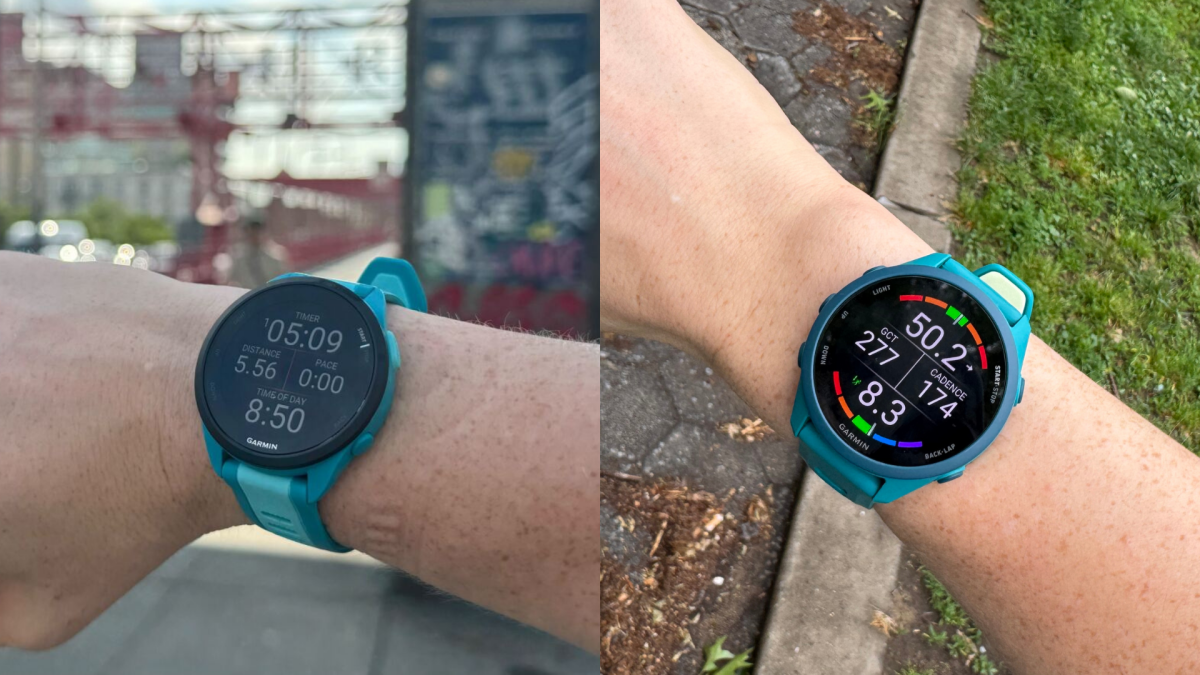
Hold the two watches side by side and you’d be forgiven for struggling to tell them apart. Both have small plastic cases with 1.2-inch AMOLED touchscreen displays and five physical buttons. Both are lightweight and comfortable on the wrist. The main visual difference is cosmetic, where the Forerunner 170 has a colorful bezel rather than the 165’s black one, and that can come in four color options.
Under the hood, both watches share the same GPS and optical heart rate sensors. If you were hoping for a major hardware leap, you’ll need to upgrade to a higher-end model. The one new sensor is a gyroscope, added to the 170 to improve movement tracking during activities.
How the Garmin Forerunner 170 Improves Upon the 165
Everything that makes the 170 worth the upgrade is in the software updates. The 170 brings analytics like Training Readiness, Training Status, and Acute Load to this tier of Forerunner - these metrics were previously reserved for pricier Garmin models, like the Forerunner 570 and 970. Training Readiness gives you a daily score to help you decide how hard to push in a workout, and Training Status tells you whether your current training load is actually improving your fitness or just wearing you down. There’s also a Quick Workout feature that lets you create a running session based purely on your desired effort level (easy, moderate, hard, or very hard) and duration. It’s a handy tool for newer runners who want structure without building their own workouts.
There are also some smaller widget upgrades worth noting, like the calculator app, and features like Lifestyle Logging, Health Status, Evening Report, and Sleep Coach that aren’t on the 165.
The Forerunner 170 lasts approximately 10 days in smartwatch mode, while the Forerunner 165 stretches to 11–13 days, depending on use. Garmin frames this trade-off as the cost of a more expansive feature set. Still, if you’re a runner who travels frequently or tends to forget to charge, the 165 has a modest edge.
Because I’m a fitness writer who loves to dive into my training analytics daily, the 170 is worth the real-world $100 upgrade. If you similarly place a high value on those advanced training metrics, the 170 is the stronger choice - but for most casual runners, the discounted 165 remains an excellent and well-priced option.