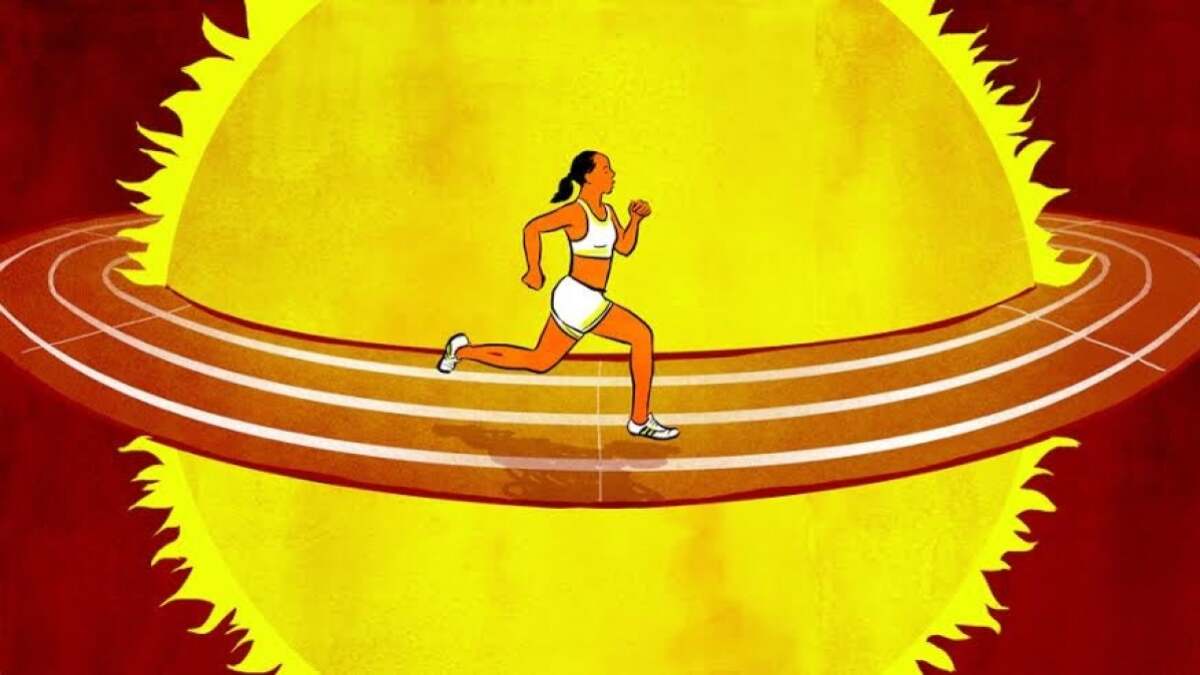
You may feel sluggish at first, but adapting to the heat can make you faster over the long term.

Nobody likes to feel sluggish and sweaty, so when the sun is set to “broil,” a lot of us would rather take our workout to an air-conditioned gym. But the human body can acclimate to exercising in the heat, so it may be worth heading outdoors anyway. After a few weeks, these temperatures will be your new normal—and research suggests you may enjoy a small performance boost when the weather cools down again.
Hot workouts can be dangerous, so I trust that you know common-sense advice about running in the heat. Among the most important: Drink to thirst (or a little bit more), and stop and get help if you start feeling symptoms of heat illness like nausea, dizziness, or weakness. And while it’s great to work on your ability to run in the heat, don’t be stupid about it—stay inside if the temperature is hotter than you can handle, and stay aware of air quality levels (which get worse on hot days).
Why Exercising in the Heat Feels So Miserable
Running is miserable and heat is miserable; therefore, running in the heat is miserable. But there’s more to it than that, and exercising in the heat feels even worse than you’d expect from stacking those two factors together.
Exercise raises your body temperature, and when you stack that rise in temperature on top of the heat from the weather, it’s very possible to reach dangerous levels of body heat. That means your body has to work harder than usual to cool itself down. The ways we cool ourselves also interfere with exercise performance. For example, your heart is working to supply blood and oxygen to your muscles, and to pump blood to the surface of your skin for cooling. Those tasks are a lot of work—no wonder we feel exhausted in the heat.
As a safeguard, your brain perceives effort differently in the heat, so even before you overheat, you feel sluggish. In a study published in the European Journal of Physiology, cyclists who worked out in a lab with a temperature of 95 degrees were slower than when they did the same time trial at 59 degrees. That makes sense, but here’s the weird part: They didn’t overheat and then slow down. They were slower from the start. It seems our brains slow our bodies down proactively on hot days in order to conserve energy.
As a workout continues, our bodies heat up. In another study, published in the Journal of Applied Physiology, when asked to cycle to exhaustion, participants pooped out when their core temperatures reached 104 degrees, no matter what temperature they started at. That’s the temperature where serious heat illness can set in, so it makes sense that our bodies will put on the brakes at that point. In that study, athletes who kept cool with a fancy water-cooling jacket lasted the longest. You can mimic this effect in your own workouts by drinking ice-cold beverages and pouring water over your head. The longer you can keep your body cool, the longer you can keep up a hard effort.
It’s the Heat and the Humidity
But cooling your body isn’t a complete solution. Dumping a cup of ice water over your head or putting one into your belly only provides momentary relief, and water-cooling jackets aren’t practical outside of physiology labs. So let’s look at what happens in real-world conditions.
Our most efficient way of cooling off is sweating. When moisture evaporates from your skin, it takes some body heat with it. In humid weather, though, sweat doesn’t evaporate as easily because the air is already full of water vapor. So when we’re talking about “heat,” we really mean something more like “perceived heat,” which is a combination of heat and humidity. This heat index chart shows the relationship:

Credit: NOAA
You’ll run slower in the heat (and humidity). The truth is that heat’s effect on your running depends on whether you’re used to the heat, and on your body size.
That’s right—not your fitness level, but your actual physical size. People who are larger have more muscle, fat, or both. Muscle generates heat, and fat acts as an insulator. On the other hand, smaller folks generate less heat, but have more skin through which to dissipate that heat—the ol’ surface area to volume ratio. This is why petite runners place better in races on hot days.
Some people think being more fit makes you better at dealing with heat, but that’s only partially true: the fitter you are, the more body heat you produce, just because you’re so good at working hard. Short of changing your body shape (which is possible, but hardly a short-term fix), what can you do to tolerate exercising in the heat better? The answer is simple: Spend more time exercising in the heat.
Why You Should Start a Heat Adaptation Protocol
Running in the heat makes you better at running in the heat—and it makes you better, period. Say you do all your workouts outdoors this summer, while your equally fit twin does identical workouts on a treadmill in an air-conditioned gym. Who do you think will finish first in a 5K on a hot weekend in August? That’s right, you will.
But even if the weather is unseasonably cool on that August day, your heat training will still help you beat your twin. Part of the magic of heat training is that it increases the amount of blood in your veins—the better to put it towards your skin for cooling, while still having enough to fuel your muscles. The effect has been compared to a mild, totally legal version of blood doping. Scientists are still debating exactly how this effect works and whether it always happens when people attempt to adapt to heat, but overall, the evidence is strong enough that making an effort to get some of those adaptations this summer is well worth your while.